
Reducing Coupling vs. Reducer Bushing: Which Plumbing Fitting Do You Need?
Reducing Coupling vs. Reducer Bushing: Which Plumbing Fitting Do You Need?
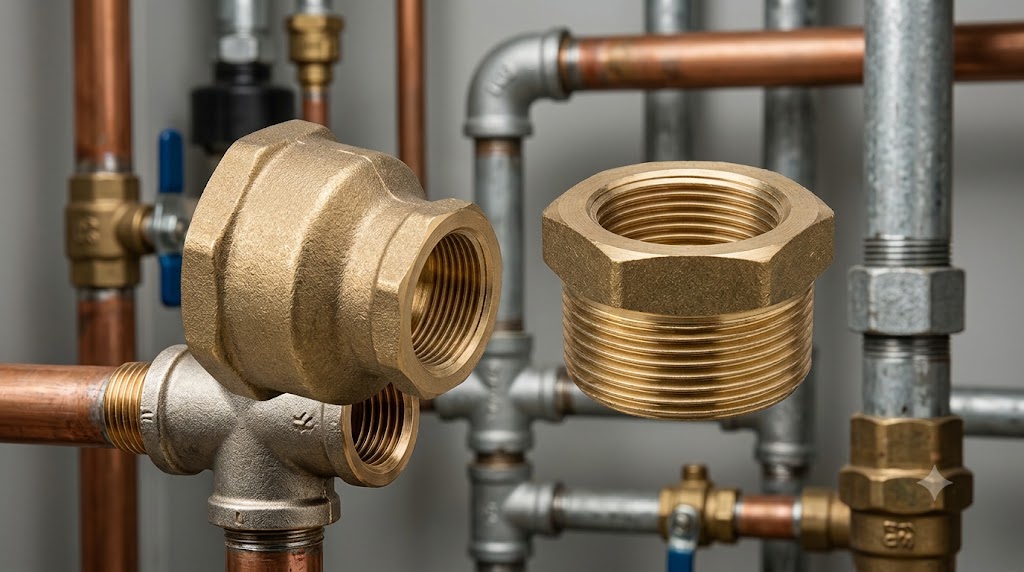
When two sections of pipe have different sizes, you need a fitting that can make the transition safely and correctly. Two of the most common options are a reducing coupling and a reducer bushing. While both can connect different pipe sizes, they work in different ways and are better suited for different applications.
A reducing coupling is a fitting with two different-sized openings. One end connects to the larger pipe while the other connects to the smaller pipe. The reduction happens within the body of the fitting, creating a direct transition from one pipe size to another.
For example, a 1-inch by 3/4-inch reducing coupling allows a 1-inch pipe to connect directly to a 3/4-inch pipe. Depending on the piping system, reducing couplings may be threaded, soldered, press-connect, socket-style, or designed for another connection method.
Reducer bushings accomplish a similar goal but have a different design. A bushing fits inside another fitting rather than connecting two pipes directly. The outside of the bushing matches the larger opening, while the smaller inside connection accepts the reduced pipe size.
For example, a 1-inch by 3/4-inch threaded reducer bushing may have 1-inch male threads on the outside and a 3/4-inch female threaded opening on the inside. The bushing threads into a larger female fitting and reduces that connection to the smaller size.
The biggest difference between a reducing coupling and a reducer bushing is therefore how the reduction is made.
A reducing coupling acts as the connection between two pipes. A reducer bushing changes the size of an existing fitting or connection point.
Reducing couplings are often the better choice when joining two straight sections of pipe. Because the reduction is built directly into the coupling, the installation can be simple and easy to understand.
Bushings are especially useful when you already have a tee, elbow, valve, coupling, or other fitting with an opening that is larger than the pipe you need to connect. Instead of replacing the entire fitting, a reducer bushing can decrease the opening to the required size.
Space can also influence the decision. Reducer bushings can create a compact transition because they fit inside another fitting. This can be helpful in crowded mechanical rooms, equipment connections, or other installations where every inch matters.
Reducing couplings may add slightly more length to the piping assembly, but they can provide a straightforward transition between two different pipe sizes without nesting one fitting inside another.
The material of the piping system also matters. Reducing couplings and reducer bushings are available in materials such as brass, black iron, galvanized steel, PVC, CPVC, copper, and stainless steel. The correct fitting should be compatible with the pipe material, pressure rating, temperature, and intended application.
For threaded systems, pay close attention to male and female connections. Terms such as MIP, FIP, MNPT, and FNPT describe the thread configuration of a fitting. A threaded reducer bushing may have male threads on the outside and female threads on the inside, while a reducing coupling commonly has female threads on both ends.
Sizing is another area where mistakes happen. A fitting labeled 1 inch by 3/4 inch generally reduces from a 1-inch nominal pipe size to a 3/4-inch nominal pipe size. Always confirm both dimensions before ordering.
It is also important not to confuse a reducer bushing with a reducing adapter. Adapters are typically used to transition between different connection types, such as threaded pipe to another style of connection. A reducer bushing is primarily designed to reduce the size of an existing fitting opening.
So which fitting should you choose?
If you are connecting two different pipe sizes directly, a reducing coupling is usually the simpler option. If you need to reduce the opening of an existing fitting, valve, tee, or other component, a reducer bushing is often the better choice.
Both fittings solve the same general problem, but choosing the correct one can reduce unnecessary connections and make the installation cleaner and more efficient.
Looking for reducing couplings, reducer bushings, or other hard-to-find plumbing fittings? Visit PlumbFounded.com to search plumbing fittings by size, material, connection type, and application.